July 15, 2026
Meta Says "People, Not AI" Picked the Layoffs. 26 Workers Sued to Find Out.
Subscribe
The first US lawsuit to challenge AI in mass firings lands a month after a judge let the Workday AI-hiring case proceed, Verizon is reportedly set to announce a third cut round Thursday, and Xbox union workers march on six studios today.
July 2026 so far (through July 15), newly announced cuts with disclosed numbers: roughly 10,670 people across 16 companies. Today's two big stories add no new headcount to that line: the Meta suit targets a May layoff, and Verizon's number is not yet public. The lead is about the mechanism going legal.
Microsoft (4,800, July 6) | Allianz Partners (up to 1,800, July 8, insurance not tech) | Meituan (fewer than 2,000, July 10) | OpenText (~400, July 8) | Talrop (300+, July 12) | Thomson Reuters (up to 500, July 13) | plus Mews, Bragg, GoKwik, Sonos, Starling, Darrow, Ubisoft, Cisco (WARN-effective), LinkedIn (WARN-effective), and smaller rounds.
Meta: the AI-substitution mechanism, now in a courtroom
Twenty-six Meta employees filed suit late Monday in US District Court in Oakland, claiming the company used a "constellation of internal artificial-intelligence systems" to score, rank, and select who got cut in the May layoff of roughly 8,000 people, about 10% of staff. The 26 are among those notified in May that their jobs end starting July 22. Reuters calls it the first lawsuit against a major US company to challenge the alleged use of AI in conducting layoffs.
The complaint, covered by CNBC and Ars Technica, names the tools: Metamate, Meta's internal large-language-model assistant; employee-trained "second brain" agents that tracked workers' communications and documents; a productivity score drawn from scanning keystrokes, screen content, emails, and browser history; AI-token-usage dashboards; and algorithmically assisted performance ranking and calibration. Internal dashboards sorted employees by AI-adoption stage into tiers labeled "AI Native," "AI First," and "AI Enabled," and token consumption became a proxy for how much an employee used Meta's own AI.
The legal bite is that those inputs, the suit says, "by design, cannot be accumulated by an employee who is on protected medical or family leave, or whose output is reduced by a disability." One plaintiff, a Meta scientist, was selected for termination while on approved pre-birth pregnancy leave, the day before her water broke and two days before she gave birth. The plaintiffs work in California, Illinois, Washington, New York, DC, Pennsylvania, and Florida, and allege violations of the Family and Medical Leave Act, the Pregnancy Discrimination Act, the Americans with Disabilities Act, the Pregnant Workers Fairness Act, and recently adopted California and New York City AI-bias laws.
Those tools draw on inputs, performance ratings, calibration scores, productivity and output metrics, "AI-native" ratings, and AI-token consumption, that, by design, cannot be accumulated by an employee who is on protected medical or family leave, or whose output is reduced by a disability.
The workers want a preliminary injunction blocking Meta from finalizing their separations, plus an independent audit that would "recompute selection scores using leave- and accommodation-neutralized inputs." It is not a class action: Meta's arbitration agreement bars that, so each plaintiff would arbitrate individually, with the court order only to preserve their jobs while that plays out.
Meta's reply is the sentence the whole case exists to test. "These claims lack merit and are not based on facts," a spokesperson told CNBC and Ars. "Workforce management and organizational decisions were and are made by people, not AI." The company did not otherwise comment.
The timing is not isolated. The suit lands roughly a month after a federal judge in California ruled that Workday must face claims its AI-powered job-screening software violated state and federal discrimination laws, the first major AI-hiring case to clear that bar. The Meta complaint is the mirror image on the firing side: if an algorithm shapes who leaves, not just who gets hired, the same bias questions apply.
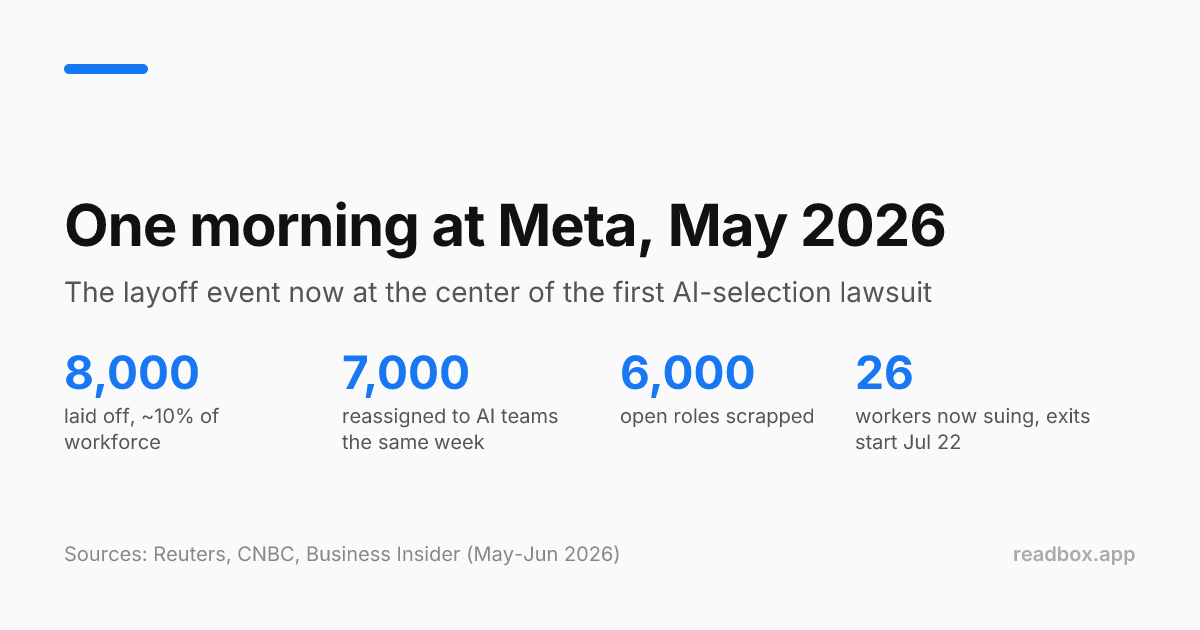
The hiring counter-signal is the same morning. While 8,000 read their layoff notices in May, about 7,000 others were "drafted" into new AI teams (Applied AI Engineering, the Agent Transformation Accelerator, and Central Analytics), and roughly 6,000 open requisitions were closed. Mark Zuckerberg told employees in a June 12 memo reported by Reuters that Meta had "made mistakes and will almost certainly make more," and said he did not expect more company-wide layoffs in 2026, even as employees told CNBC to watch for a round in August. The Applied AI unit, about 6,500 engineers, was reported by Wired to be "on the verge of revolt," with draftees generating coding puzzles to train models, more than 1,600 signing a petition against the keystroke-monitoring Model Capability Initiative, and CTO Andrew Bosworth conceding the rollout was "atrocious."
The stated reason is a workforce reallocation toward AI, backed by as much as $145 billion in 2026 AI infrastructure spending. The plausible real mechanism, read straight from the suit, is that Meta built an internal scoring layer that made AI adoption a job-retention metric, then ran mass cuts through it. Whether a person "pressed the button" or an algorithm "built the list" is exactly what the audit would settle.
Verizon: a third cut round is reportedly set for Thursday
Verizon is preparing to announce another round of layoffs on Thursday, July 16, Barron's reported Tuesday, sending the stock down on the day. The number of affected employees is not yet known.
This would be the third wave under CEO Daniel Schulman, who took the role in October 2025. Verizon cut 13,000 jobs in November 2025, the largest layoff in its history, followed by another round in May. The company ended 2025 with about 89,900 employees worldwide. On a January earnings call Schulman set a target of $5 billion in 2026 operating-expense savings and said a "substantial portion" would come from headcount reductions, a figure he reiterated at a May investor conference.
The cost reset runs alongside the roughly $20 billion acquisition of Frontier Communications, which closed in January, and tighter 2026 capital spending of $16 billion to $16.5 billion. Schulman has pointed to AI and automation as a customer-service cost lever, saying it has lowered costs while raising satisfaction. Frontier workers carry a four-year protection against involuntary layoffs under the merger's regulatory terms, which means the new round will fall on the legacy Verizon side. Verizon reports second-quarter results on July 24, a week after the planned announcement.
The stated reason is a cost reset to fund network investment and Frontier synergies. The plausible real mechanism is declining wireless market share against AT&T, T-Mobile, and satellite entrants, debt from spectrum and Frontier, and automation pulling cost out of customer-facing operations. This is telecom, not pure tech, but it is one of the largest AI-in-the-cost-stack restructuring stories of the year, and the number lands Thursday.
Save Our Devs: Xbox union workers march today on six studios
The "Save Our Devs" march the unions announced last week happens today, July 15, at 12:30pm local time across six locations, one more than the original four-city plan: ZeniMax and Bethesda in Rockville, Maryland; ZeniMax in Austin, Texas; id Software in Dallas (Richardson), Texas; the Microsoft campus in Redmond, Washington; Obsidian Entertainment in Irvine, California; and Victoria Square in Montreal for Bethesda Montreal. The Communications Workers of America says more than 400 of its members were cut across Bethesda Game Studios, ZeniMax Online, id Software, ZeniMax Workers United QA, and ZeniMax corporate.
New day-of reporting adds the texture the WARN filings could not. Game Developer and BBC Newsbeat spoke to laid-off staff who describe the calls that delivered the news: chat disabled, microphones muted, and in one case cameras automatically turned off so the managers reading the script could not see their colleagues' faces. The call announcing cuts at id Software, where 136 people assigned to the Texas office were let go, reportedly lasted under 60 seconds, with an Outlook invite sent about 10 minutes before it started, too late for some commuters to dial in. A major expansion for Doom: The Dark Ages, called Revelations, shipped the day after one id employee learned he was among nearly 100 staff cut. At ZeniMax Online Studios, a bargaining-committee member estimates some disciplines are down to a quarter of their former size.
The march is the first organized labor action against the Xbox reset, and the unions' goal is "effects bargaining": severance, transfers into open roles, healthcare, and recall rights, plus arguments to reinstate some workers. The WARN-effective date for the covered cuts is September 4. Xbox CEO Asha Sharma, who framed the cuts as "entrepreneurial change in scope," was appointed to co-lead a US Federal Reserve Productivity and Jobs task force on July 9, an irony the unions have not let pass. With 1,600 of the 3,200 planned cuts still scheduled across the fiscal year, remaining staff told the BBC they are worried about morale, not just headcount.
Tracking: the Meta suit is the AI-substitution storyline's first courtroom test. The Verizon round, if announced Thursday with a number, joins the July tally next issue. The Save Our Devs march closes the first labor chapter of the Xbox reset; the WARN-effective date September 4 is the next.
Want the next one?
Every new Tech Layoffs Tracker issue by email. One tap to unsubscribe.