July 18, 2026
A Federal Judge Won't Block Meta's Layoffs Wednesday, and Wants Answers on 4 Visa Firings by Thursday
Subscribe
The 26 employees who sued Meta over AI-selected cuts lost their emergency bid Friday, but the judge carved out four workers on visas and gave Meta until next Thursday to explain their selection; Exodus cut a quarter of its staff to become a payments company, Entain shed 500 roles months after its CEO promised no cuts, and the Disco Elysium studio let up to 32 go after its new game flopped.
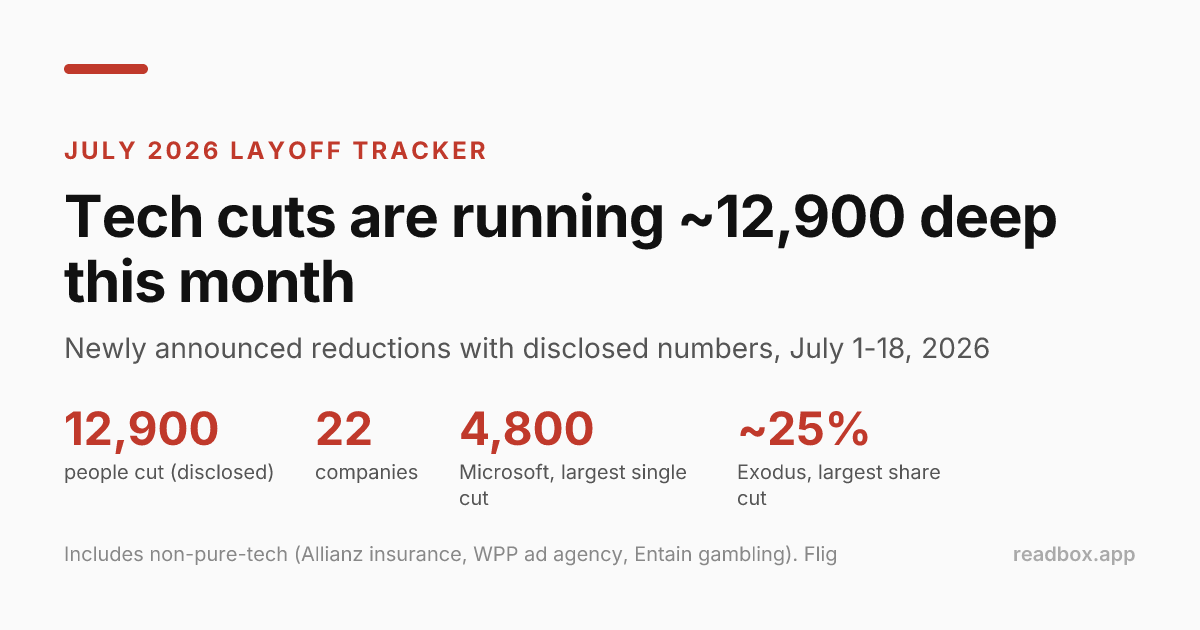
July 2026 so far (through July 18), newly announced cuts with disclosed numbers: roughly 12,900 people across 22 companies. The biggest: Microsoft (4,800, July 6), Meituan (fewer than 2,000, July 10), Allianz Partners (up to 1,800, July 8, insurance not pure tech), Thomson Reuters (up to 500, July 13), Verizon (~500 corporate, July 16), Entain (500, July 17, gambling not pure tech), Sprout Social (~260, July 15), Redis (~200, July 15), WPP (several hundred, ad agency not pure tech). Today's three new cuts add 609.
Meta's AI-layoff plaintiffs lost their emergency block. The judge kept one door open.
The 26 employees who sued Meta last Monday asked a federal judge to freeze their layoffs before Wednesday, when most of them are scheduled to be finalized. On Friday, Senior U.S. District Judge William Orrick in Oakland said no.
"Without downplaying the serious consequences of being laid off from employment, I do not find that the plaintiffs have suffered or will suffer irreparable harm," Orrick wrote, per Courthouse News. Loss of health insurance, protected leave time, and unvested equity are all things money can fix through damages and back pay in arbitration, he reasoned, so they do not meet the bar for an emergency order.
One piece of the case survived. Four foreign-born plaintiffs on Meta-sponsored work visas face "an imminent threat of removal from the United States" if they do not find new work within 60 days, Orrick found, and that harm is "more than speculation." He asked Meta to file a declaration by next Thursday explaining how and why those four were selected. Meta attorney Erin Connell told the court "there is no evidence that AI was used to make decisions in this reduction in force," calling the workers' theory "speculation and conjecture." Orrick noted Meta's denials were "unequivocal" but said more discovery is needed to test them.
What this means in practice: the July 22 separations go ahead. The longer preliminary-injunction motion is still pending, and Orrick said he would likely rule on it at an August 24 hearing, where he can reconsider the AI question with actual evidence rather than declarations. The first U.S. lawsuit to challenge AI in mass firings survives on its claims but not as an emergency brake.
Exodus cut a quarter of its staff to become a payments company.
Exodus Movement (NYSE American: EXOD), the self-custodial crypto wallet maker, said Friday it is cutting about 25% of its global workforce, roughly 77 employees and contractors, to refocus as a full-stack card-issuance and stablecoin-payments platform.
The cut lands about ten weeks after Exodus finally took control of the payments assets it had been chasing. It agreed in November to buy W3C Corp, parent of Monavate and Baanx, for $175 million, then sued W3C and its CEO in April to force the deal through, and on May 1 acquired the U.K. and U.S. entities out of receivership for roughly $106 million in cash plus deferred consideration, well under the original headline. A 25% workforce review after a receivership acquisition is a de-duplication move, not a standalone cost cut.
CEO JP Richardson's quote in the release: "These decisions are never easy because they affect talented people who have helped build Exodus. We are deeply grateful for their contributions and committed to supporting them through this transition." Exodus expects $2.5-3.5 million in pre-tax charges, mostly severance, and $10-13 million in annualized cash savings with the full benefit in 2027. Affected staff get severance, continued benefits, and transition support.
The mechanism is acquisition-driven refocus plus crypto-cycle expense discipline, the same pattern as Polygon Labs the day before, not AI. Exodus shares trade near their 52-week low. The bet is that Monavate, which management says could contribute more than 40% of revenue by 2027, replaces the declining swap-fee business faster than the legacy revenue compresses.
Entain is cutting 500 jobs months after its CEO said it would not cut any.
Ladbrokes and Coral owner Entain confirmed Friday it will cut about 500 roles, roughly 2% of its roughly 28,000-person global workforce, under an efficiency program led by new CFO Michael Snape, who took over in March. The cuts fall on corporate functions (people, finance, governance) and the product and technology teams, not the betting shops, per Racing Post and NEXT.io.
The awkward detail is the reversal. In March, CEO Stella David told Bloomberg Tax the company was "not about job cuts at all, it's about gaining share," and expected trimmed marketing and customer bonuses to offset more than half of the hit from the U.K. budget. Four months later, the layoffs are the plan, Gaming.net notes. The pressure is real: the U.K. nearly doubled remote gaming duty to 40% in April, which Entain estimates adds about £200 million to annual costs before mitigation.
Gambling is not pure tech, flagged here the same way Allianz and WPP are. But product and engineering teams take a meaningful share of this cut, and the CFO-led, tax-driven, "efficiency and agility" framing is the same template enterprise tech has used all year. AI is not cited. The real mechanism is a cost lever pulled once the smaller levers ran out.
The Disco Elysium studio let up to 32 people go after its new game flopped.
ZA/UM, the studio behind Disco Elysium, has served redundancy or at-risk notices to up to 32 staff across all departments, The Verge reported Friday. The cause is unusually direct: the studio's new game, Zero Parades: For Dead Spies, did not sell.
"While Zero Parades: For Dead Spies was released to critical acclaim, its commercial performance has not enabled us to sustain a studio of our current size," ZA/UM wrote. The studio has been radioactive with its own fanbase since the bitter, litigious split from the Disco Elysium creators, and reviewers flagged that uphill climb before launch. No AI framing, no restructuring euphemism. A small, clean commercial-failure cut.
Alibaba's Fliggy is quietly cutting, and naming AI as one of the reasons.
Fliggy, Alibaba's online travel arm, has been cutting jobs across several departments since June as it struggles against Trip.com's dominance in the Chinese online-travel market, Caixin reported Friday. The number is undisclosed. The stated mechanism is the combination readers of this feed have seen all month: streamlining operations and relying on artificial intelligence to cut costs "amid a challenging macroeconomic environment." It fits the running China AI-displacement pattern alongside Meituan and the Xiaomi/Baidu cuts, with the same euphemism gap between "AI optimization" and a business losing a market-share fight.
The counter-signal: the companies that swapped people for AI are hiring them back.
While this week's cuts lean on acquisition pivots and tax pressure rather than AI, the AI-substitution story that dominates the back catalog is bending in an interesting direction. Fast Company, citing CNBC, reports that about half of companies that swapped people for AI are experiencing a boomerang effect, rehiring at greater expense than keeping the original staff would have cost.
The clearest case is Klarna, which made itself the poster child for AI customer-service replacement by claiming its chatbot did the work of 700 agents, then quietly started rehiring humans after customer satisfaction deteriorated. Ford brought back 350 veteran engineers to catch quality failures its automated systems missed, crediting the move with hundreds of millions in warranty savings, per AI in Plain English. Robert Half finds 29% of companies that cut for AI have already rehired, and Gartner predicts half will by 2027, often under new "AI output quality" or "agent supervision" job titles. The most instructive counter-example is Ingka Group (Ikea), which trained an AI chatbot to handle 47% of calls and retrained the 8,500 at-risk workers as interior-design consultants rather than firing them.
None of this undoes the 12,900 July cuts. But the mechanism is getting more complicated than "AI ate the role," and the rehire budgets are reportedly running 20-35% above the original salaries. That is the hiring counter-signal worth holding against every "AI-native" cut in this tracker.
Tracking
- Xbox reset: no new cuts this cycle. 1,600 of the 3,200 remain scheduled across the fiscal year; WARN-effective dates hit September 4. ZeniMax Online's departing leadership stays through "the next few months" for transition.
- Verizon: third round confirmed Thursday at ~500 corporate jobs plus ~2,500 retail transfers to franchisees. The next real signal is Q2 earnings on July 24, where CEO Dan Schulman's $5 billion OpEx savings target meets the headcount question.
- Meta: separations begin Wednesday, July 22, four days out, now unhindered by the court. Preliminary injunction hearing August 24.
- Redis and Thomson Reuters: the talent is already being intercepted. Refolk estimates Redis's ~80 Tel Aviv departures added roughly 40 senior AI-infra engineers to a national Israeli pool of 91, and that Thomson Reuters's 500 cut, against ~1,191 findable engineers, is a 42% hit to its visible engineering pool with a two-week intercept window before the July 27 last day.
Excluded this run as stale re-surfaces: Ubisoft's "380 jobs" (a June 10 announcement repackaged July 18), Matter Labs/ZKsync (a June 17 pivot), StarkWare (an April event), Coinbase's 14%/700 (a May 5 SEC filing), MANTRA (weak single source only).
Want the next one?
Every new Tech Layoffs Tracker issue by email. One tap to unsubscribe.