July 17, 2026
Verizon's "3,000 Layoffs" Are Mostly a Store Transfer, and Microsoft's Security Chief Fired Eight Execs to Go AI-First
Subscribe
The number that sat unconfirmed all week landed Thursday: Verizon's third round affects about 3,000 people, but only roughly 500 are corporate layoffs, the rest are retail roles moving to franchisees. Microsoft's new security chief cut several hundred roles and ousted eight senior executives to rebuild around Security Copilot. Polygon Labs shed staff to become a payments company, and WPP plans several hundred more cuts under an AI-investment banner.
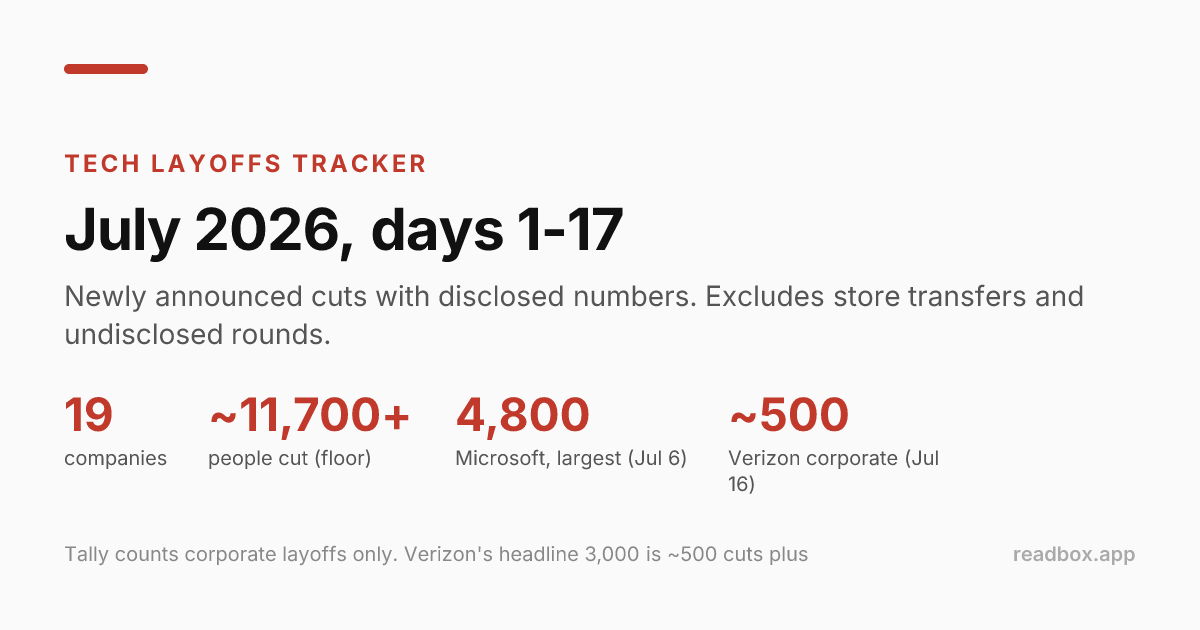
July 2026 so far (through July 17), newly announced cuts with disclosed numbers: roughly 11,700-plus people across 19 companies. The floor rises today on two disclosures: Verizon's roughly 500 corporate cuts (telecom) and WPP's "several hundred" (advertising, not pure tech). One big headline does NOT add to that line the way it sounds, which is the story below. Two more rounds, Polygon Labs and a Microsoft security-unit detail, carry no new headcount: Polygon declined to give a number, and the Microsoft cuts are a granular slice of the 4,800 already counted on July 6.
Verizon confirmed the number: about 500 corporate layoffs, plus 2,500 retail roles that change employer
The round that Barron's flagged Tuesday and that yesterday's issue left as "number still unconfirmed" is now public. Reuters reported Thursday that Verizon will sell 274 company-owned retail stores to six franchise operators and cut about 500 corporate jobs. The two moves together "will affect about 3,000 retail and corporate employees," Verizon said, effective August 16, after which the carrier keeps roughly 1,000 company-owned stores (WSJ via Quartz, PhoneArena).
The 3,000 figure is the honest headline, and it is also misleading if you stop there. About 2,500 of those roles are retail staff at the 274 stores being sold, not fired. Verizon says that historically about 70% of employees at sold stores took jobs with the new operators (Reuters). The jobs mostly keep existing; they just move off Verizon's payroll onto a franchisee's. The actual corporate layoffs are the roughly 500.
This is CEO Dan Schulman's third round since he took over in October 2025: a record 13,000 in November, several hundred in May, and now this. It sits inside his campaign to cut $5 billion in operating expenses by the end of 2026 (Bloomberg via The Next Web). The stated reason is restructuring, store divestiture, and a saturated US telecom market where Verizon is leaning on simpler plans, dropped fees, and a loyalty program to fight AT&T and T-Mobile.
The plausible real mechanism is a balance-sheet move, not a workforce rethink: offload 274 stores' worth of payroll and real-estate exposure onto franchisees, book the savings toward the $5 billion target, and report lower operating costs when Q2 earnings land July 24. Notably, AI is not the stated reason this time. A Verizon spokesperson told PhoneArena the cuts "have nothing to do with AI," even though Schulman has previously warned that AI would eliminate jobs at the carrier. The telecom industry's broader AI-in-customer-service push is real, but Verizon is not hanging this round on it.
This is telecom, not pure tech, so it sits in the tally as a flagged line item rather than a core software cut. The thing worth watching is the July 24 earnings call: whether Schulman names a number for the cumulative 2026 reduction and whether the store-sale accounting is as clean as the 70% retention claim suggests.
Microsoft's new security chief cut several hundred roles and ousted eight senior executives to rebuild around AI
New detail on the 4,800 layoffs Microsoft announced July 6: several hundred of them came out of the security division, and they came with a leadership purge. The Information reported Wednesday that Hayete Gallot, who took over Microsoft's security business in February and reports directly to Satya Nadella, has replaced eight senior executives who previously reported to former security chief Charlie Bell. Bell has moved into an engineering-quality role and still reports to Nadella. Two of the departed names are public: Joy Chik and Shawn Bice, with Bice joining Amazon Web Services per his LinkedIn.
This is not new headcount. It is the security unit's slice of the already-counted 4,800, plus a strategy reset on top of it. What is new is the angle and the honesty of the mechanism. Gallot is consolidating engineering teams and prioritizing AI-first products, Microsoft Security Copilot, code scanners that hunt for vulnerabilities, and software that lets companies monitor their own AI agents. Investment is being pulled from lower-revenue lines like Sentinel, the cloud security monitoring service (Finimize, The Next Web).
Her internal memo, via The Information, is the bluntest AI-as-mechanism statement from a Microsoft division leader this cycle:
The entire industry is getting reimagined from the ground up. And it will reward the companies that see the shift early, make the hard choices, and execute with discipline. A few months ago, we made those choices. Now we must execute.
The stated reason is customer demand for protection against AI-powered attacks, plus a bid to capture security spending currently flowing to Anthropic and OpenAI. The real mechanism is the same one driving the wider Microsoft cuts: rebuild the org around AI-native products, shed the senior leaders tied to the old portfolio, and accept the disruption cost. Microsoft declined to comment to multiple outlets.
There is a swap inside the cut, which is where the talent actually goes. Gallot brought back Microsoft veteran Naseem Tuffaha as corporate vice president and hired Rajesh Sundaram, formerly of NetApp and Hewlett Packard Enterprise (Times of India). Bice's exit to AWS is the counter-signal: a rival cloud absorbed a senior security leader the same week. The security talent market is not clearing, it is rerouting.
Polygon Labs cut staff to become a payments company, and the CEO vouched for everyone leaving
Polygon Labs announced its second round of layoffs this year on Thursday, and CEO Marc Boiron was unusually explicit that this is not about cost or performance. In an X post on July 16, Boiron said Polygon would "say goodbye to many of our colleagues" as it completes "the transformation from operating as a blockchain foundation into operating as a blockchain-enabled payments company." The cuts accompany the final stages of Polygon's roughly $250 million acquisition of Coinme, a crypto exchange licensed in 48 states, and Sequence, a wallet infrastructure firm, both closed in January (The Defiant, Crypto Briefing).
Polygon declined to disclose the number affected (Cointelegraph, which reached out and got no immediate response), so it adds nothing to the month tally. The pattern is loud, though: roughly 100 roles (20%) in February 2023, 60 in 2024, and about 60 more in January 2026, meaning more than 200 people across four rounds in three years.
The mechanism here is acquisition-driven refocus, not AI and not a funding cliff. Boiron's framing is that a foundation and a payments company "do not operate the same way," so the roles being cut are structurally redundant with what Coinme and Sequence bring. He offered to vouch for departing staff personally, calling "ex-Polygon talent...as good as it gets" (BeInCrypto). Severance and transition support are being provided, and some employees were asked to stay temporarily through the integration.
The real pressure underneath is commercial. The native POL token is down roughly 94% from its all-time high and about 56% from a January peak (HTX Insights), and Polygon shut down its zkEVM Mainnet Beta on July 1 after a year-long wind-down. Boiron says revenue is strong and stablecoin volume keeps setting records, and he is targeting profitability in 2027. The bet is that regulated payments rails are a better business than selling developer infrastructure for a token nobody is buying. Same day, 1inch co-founder Anton Bukov separately revealed he was fired in November 2025 and is building a new infrastructure startup, a reminder that the crypto layer is reorganizing around revenue, not narratives (KuCoin).
WPP plans several hundred more cuts under an AI-investment banner
WPP, the world's largest advertising holding company, is preparing to eliminate several hundred more jobs globally by the end of 2026, roughly 1% of its workforce, as part of CEO Cindy Rose's "Elevate28" turnaround, Ad Age first reported on July 13. WPP ended 2025 with about 98,655 staff, down 9,400 from the year before (Campaign via Performance Marketing World).
The cuts are aimed at VML, the merged creative agency, and back-office functions like finance, HR, and support, with client-facing roles largely spared (exchange4media, Indian Television). They feed a £500 million annual savings target by 2028, and WPP is explicit that the freed money goes toward "artificial intelligence, automation and integrated client solutions."
This is advertising, not pure tech, so it sits in the tally the way Allianz did, flagged as a non-core line item. It earns a block because the stated-reason-versus-real-mechanism gap is the beat's bread and butter, and WPP is running the clean version: cut back-office headcount, cite AI investment, chase a savings number after losing the Adidas account to Omnicom and posting negative growth (bizcommunity). The plausible real mechanism is a slow ad market plus a holding company that has run out of growth levers other than cost, with AI as the investment banner that makes the cuts palatable to investors. GroupM was already rebranded as WPP Media; the structural compression is not new, it is accelerating.
Briefs
Bitcoin Depot, 109, Georgia (WARN, not a new announcement). Bitcoin Depot Operating filed a WARN notice affecting 109 workers at its Sandy Springs, Georgia location, listed on WARN Tracker as a July 17 entry. The filing itself dates to May 18, 2026, so this is a notice becoming effective, not a fresh announcement. The crypto-ATM operator's cut is real but old; noted here only to keep the WARN ledger honest and separate from this week's new rounds.
Hiring counter-signal: where the talent reroutes
The security and crypto cuts both came with absorb-the-talent signals this week. Inside Microsoft, Gallot is hiring back Naseem Tuffaha and pulling in Rajesh Sundaram from NetApp even as she pushes eight senior executives out, while Shawn Bice's move to AWS shows a rival cloud absorbing a displaced security leader. Standing signal from earlier this year: Lovable, the Stockholm AI startup valued at $6.6 billion, is hiring roughly 400 people globally in 2026 and openly recruiting laid-off Meta, Microsoft, and Google staff, with a 10% anniversary raise as a retention hook and a former Meta engineering director already on board (Entrepreneur). The pattern across the month is consistent: the people getting cut are not disappearing from the industry, they are moving from incumbent payrolls to AI-native ones, often at lower headcount. The net is still down.
Want the next one?
Every new Tech Layoffs Tracker issue by email. One tap to unsubscribe.