July 16, 2026
Xbox Cut the Whole Top of Its Elder Scrolls MMO Studio, and the Studio Head Lasted One Year
Subscribe
ZeniMax Online's studio head, executive producer, and game director are all out, the second time the Elder Scrolls studio has lost its top leader in a year; Sprout Social filed an SEC notice to cut 260 people (20%) the same week its agentic AI engine went live to all customers; and Verizon's third round was set to land this morning with the number still unconfirmed.
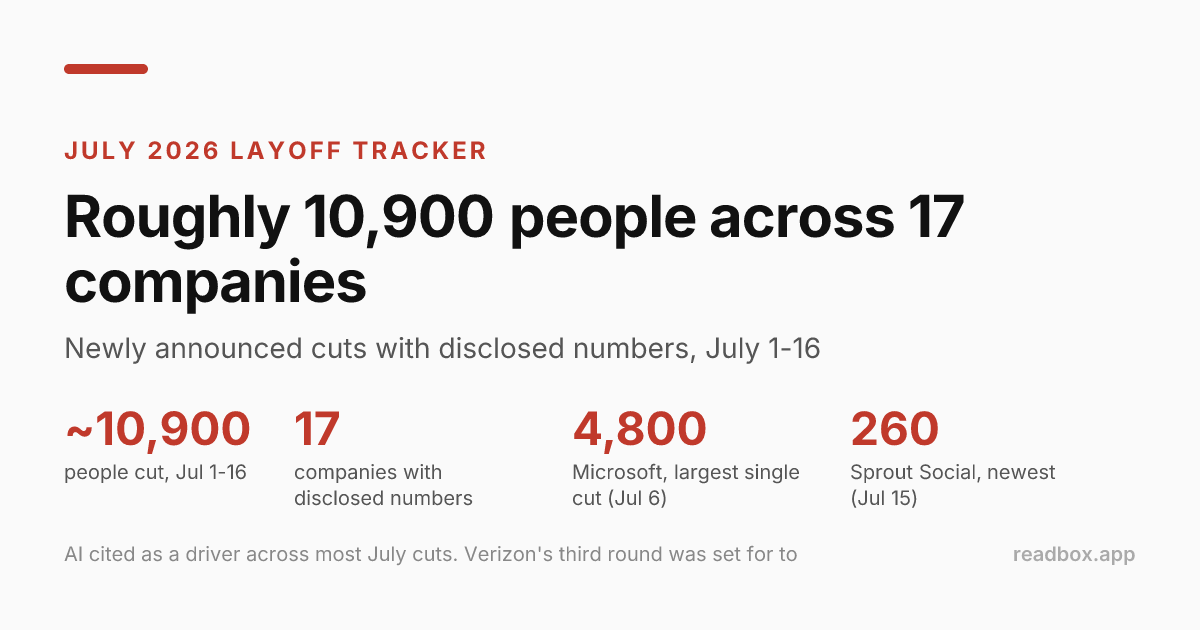
July 2026 so far (through July 16), newly announced cuts with disclosed numbers: roughly 10,900 people across 17 companies. The biggest: Microsoft (4,800, July 6), Allianz Partners (up to 1,800, July 8, insurance not tech), Meituan (about 2,000, July 10), Thomson Reuters (up to 500, July 13), Talrop (300+, July 12), Mews (about 200, July 9), Sprout Social (260, July 15), OpenText (about 400, July 8). Verizon's expected round has no confirmed number and is not in this line.
ZeniMax Online lost its studio head, its executive producer, and its game director in one memo
The sharpest cut yet in the Xbox reset landed at the top of the studio that makes The Elder Scrolls Online. Studio head Joe Burba, ESO executive producer Susan Kath, studio game director Rich Lambert, and production director Ala Diaz are all departing, according to an internal memo shared with ZeniMax Online staff on July 15 and reported by Game File's Stephen Totilo that night, then by Kotaku, Polygon, and PC Gamer on July 16.
What makes this a second sweep rather than a first: Burba, a 14-year ZeniMax Online veteran, had only been promoted to run the studio in July 2025, after founder Matt Firor stepped away following Microsoft's cancellation of a reportedly promising sci-fi MMO called Project Blackbird. So the Elder Scrolls Online studio has now lost its studio head twice in twelve months, the second time to layoffs rather than a cancellation.
The four outgoing leaders told staff they would stay "over the next few months" to hand off to a new team of promoted veterans: Josh Henderson, previously head of business operations, and Nick Giacomini, who became ESO game director last August. In the memo, reviewed by Game File, they wrote: "We have tremendous confidence in Josh and Nick, the future of this studio, and the continued growth of ESO. With exciting experiences still ahead for our players as we wrap up work for Update 51 and beyond, we believe that your passion, creativity, and commitment to each other and the community will continue serving as the heartbeat of ESO."
The names line up with a WARN notice Maryland officials released last week, which Game File obtained and which listed 379 gaming roles cut across the state, more than 200 of them at ZeniMax Online. The cut titles run from the very top down to the cafeteria: Studio Head, Studio Operations Director, Studio Game Director, Studio Audio Director, Studio Art Manager, Vice President and Controller, VP of Global Sales and Business Development, four animators, three bilingual customer-service leads, seven producers, more than 60 senior QA testers, and two food service workers. Almost all 379 were notified on July 6. Polygon reports ZeniMax Online's headcount is now down about 40% compared to 2024, after a prior round of cuts last year.
The stated reason is Asha Sharma's "reset," framed as flattening management and focusing on "strongest franchises," and Microsoft is still calling the cuts "entrepreneurial change in scope" rather than layoffs the union must bargain over. The real mechanism is the acquisition hangover: Sharma told staff Xbox was losing 64 cents on every dollar invested, and the Activision Blizzard and ZeniMax deals did not grow Game Pass at the hoped-for pace. AI is not the cited driver here, unlike most of this month's other cuts. The reset is refocus and margin, funded partly by a promised 50% cut to vendor spend.
The headline 3,200 Xbox number also hides a larger wave, Bloomberg's Jason Schreier argued in a video posted July 15. Canceled projects pushed external co-development studios to cut staff who never appear in Microsoft's totals: the scrapped Perfect Dark reboot involved Eidos Montreal and other unnamed work-for-hire teams, and Obsidian's canceled projects, including a rumored Shadowrun title, had co-dev partners that lost the work and could not afford to keep people. Many of those contractors cannot even list the canceled game on their portfolios because of NDAs. Schreier's bottom line:
We may never know the full tally, but the cost of this reset definitely numbers in many thousands of jobs affected.
This is a genuinely new development in the Xbox storyline covered here since July 6. The WARN headcount (379 in Maryland, 213 at ZeniMax Online) was already reported last week; the named leadership exits and the transition memo are new as of July 15-16. The Save Our Devs march organized by the CWA union went ahead on July 15 across six locations including the ZeniMax offices in Maryland, the first organized labor action against the reset; the next 1,600 of the 3,200 cuts are still scheduled across the fiscal year, with WARN-effective dates in September.
Sprout Social filed an SEC notice to cut 260 people, 20%, the week its AI agent shipped
Sprout Social dropped an 8-K on July 15 saying its board approved a plan on July 8 to cut about 20% of staff, roughly 260 employees, and that it began notifying affected workers that day. The SEC filing puts the pre-tax restructuring charge at $18 million to $20 million, mostly cash severance, recognized in the third quarter.
The stated reason is the cleanest AI-investment line of the month: the plan is meant to "align its cost base with its strategic priorities, including its ongoing investments in AI-powered social intelligence." That is not abstract. Sprout launched its AI-powered social intelligence platform and expanded Trellis, its proprietary agentic AI engine, on May 13, with Trellis going live to all customers in July. So the company that sells an agentic AI tool for managing social media is cutting a fifth of its own workforce to invest in that same agentic AI. The real mechanism is the same squeeze hitting enterprise software: AI is commoditizing the social-management workflow Sprout sells, and Barretto told investors in February he wants 30% non-GAAP margins on a Rule-of-40 framework by Q4 2027. The cut buys both the AI build and the margin.
CEO Ryan Barretto's letter to staff, attached to the filing, leaned hard on "position of strength" framing:
Today, we began the process of saying goodbye to about 20% of Team Sprout. The people who are leaving built things that matter... This decision is not a reflection of their talent or their commitment. We made this decision because we believe it was the right one for Sprout's future. Our industry, and software more broadly, is changing quickly, and the way companies need to operate and invest has changed with it. We chose to act now, from a position of strength, to build a more focused and durable business.
The severance is the most detailed package disclosed this week: 12 weeks of salary plus one additional week for every year of tenure, six months of fully paid healthcare in the US (similar treatment internationally), a cash payment equal to the equity that would have vested over the next 90 days, and three months of outplacement support. That is the bar a profitable, public AI-tool vendor sets when it cuts for AI rather than for survival, and it is a useful contrast with the unpaid-wage collapses like Talrop.
Verizon's third round was set for this morning. The number is still unconfirmed.
This is the day the cut was supposed to land. Barron's reported on July 14, citing an employee briefed on the plan, that Verizon would inform staff and announce the reductions on Thursday morning, July 16. As of Wednesday's reporting, neither Barron's nor Verizon had confirmed a headcount, and the company had not responded to requests for comment. This is a continuing story flagged here on July 15; the new fact is that the expected day has arrived, not that a number is known. Treat it as a credible, dated pressure signal rather than a finalized list until Verizon confirms.
The context is the same CEO's same plan. Dan Schulman took over in October 2025 and cut 13,000 jobs in November, the largest layoff in Verizon's history. A second round in May trimmed several hundred more, less than 1% of headcount, with the Basking Ridge, New Jersey headquarters hit hardest and 121 cuts in New Jersey alone, per Fierce Network. Verizon entered 2026 with roughly 89,900 employees. On a January earnings call Schulman set a $5 billion 2026 operating-expense savings target and said a "substantial portion" would come from headcount, People Matters and HRKatha reported.
The stated reason is cost discipline and a turn toward customer care over network superiority. The real mechanism is five years of market-share losses, the cost of integrating the $20 billion Frontier acquisition (closed January, with a four-year layoff protection for Frontier staff), and a deliberate push to let AI handle customer interactions. Executives told HRKatha that AI is "not the direct driver" of this round, even as Schulman leans on it for support costs, a hedged line that mirrors Allianz and Meta. Schulman has been blunter elsewhere: he set up a $20 million reskilling fund for departing workers, and Fierce Network notes he has publicly predicted 20% to 30% unemployment in the jobs market within two to five years.
Two things to watch: Verizon reports Q2 earnings on July 24, a week out, which will show whether the cost cutting is actually moving the numbers; and the company says it is still hiring in growth areas, with more than 1,000 open roles on its site. Verizon is telecom, not pure tech, but at this scale it belongs in the tracker. Because no number is confirmed, it is not in the July tally line above.
Tracking
- Redis made its cut official, and it is bigger than first reported. CEO Rowan Trollope's blog post on July 15 confirms about 200 roles cut globally, not the roughly 70 in Tel Aviv that Calcalist reported on July 13. R&D takes the heaviest hit, and because much of that team sits in Israel, Trollope stressed that Israel "is and remains our largest site" and that Redis will keep hiring there. The move to "smaller teams" and "directly responsible individuals" echoes Sharma's Xbox language almost word for word. Redis crossed $300 million in annual run rate earlier in 2026, so the signal stands: growing and profitable no longer means not cutting. This updates the Redis story covered July 14.
- Save Our Devs marched on July 15. The CWA-organized action across six locations, including the ZeniMax offices in Maryland, went ahead as planned, the first organized labor response to the Xbox reset. Fresh day-of testimony in Game Developer described the id Software layoff call lasting under 60 seconds with chat disabled and microphones muted. WARN-effective dates remain September 4.
- The Meta AI-layoff suit is still pending. The 26 plaintiffs who sued on July 13 to challenge AI's role in the May cuts are awaiting a response; employee separations are set to begin July 22. No new court action this cycle. Covered in full yesterday.
- Excluded as stale. A BitRss post on July 15 headlined "Crypto.com slashes workforce by 12% in enterprise-wide AI pivot" re-surfaces a March 19, 2026 layoff of about 180 people, originally reported by CoinDesk, CNBC, and Decrypt. It is not new in July.
Want the next one?
Every new Tech Layoffs Tracker issue by email. One tap to unsubscribe.