July 21, 2026
Intel Layoffs Hit Its Data Center and AI Group, Growing 22%, Before Thursday Earnings
Subscribe
Intel told employees in its Data Center and AI Group to expect cuts in a Monday statement to The Oregonian, refusing to disclose a number even as the division's first-quarter revenue grew 22 percent to $5.05 billion and the stock surged 464 percent in a year; Xero's chief executive framed a 30-day "perform or leave" program as meeting "the AI moment" while selling her last shares; and Meta's 4,665 California and Washington WARN separations become final Wednesday.
July 2026 so far (through July 21), newly announced cuts with disclosed numbers: roughly 13,300 confirmed layoffs across 25 companies, plus about 739 Samsung relocation-affected roles. Two of today's cuts carry no disclosed headcount, Intel's Data Center and AI Group and Xero's "Opt Out" program, so neither enters the running count. The full tracker lives at tech-layoffs.readbox.app.
Intel is cutting the division that makes its AI chips, and won't say how many
Intel has initiated a fresh round of layoffs inside its Data Center and AI Group, the unit that builds server CPUs, custom AI chips, and data center architecture. The company confirmed the cuts in a written statement to The Oregonian, first reported Monday and picked up by Tom's Hardware, Firstpost, and the Times of India.
As part of our broader strategy to become a more focused and efficient company, (the data center group) is aligning its organization to ensure it has the right roles and skills in place to position the business for long-term success.
Intel said the restructuring will let it operate with "greater simplicity and speed" and will not affect product commitments or roadmaps. It did not disclose how many people will be cut, which locations will be hit, or when the separations will finish. "We are committed to treating all impacted employees with respect and providing resources to support them through this transition," the company added.
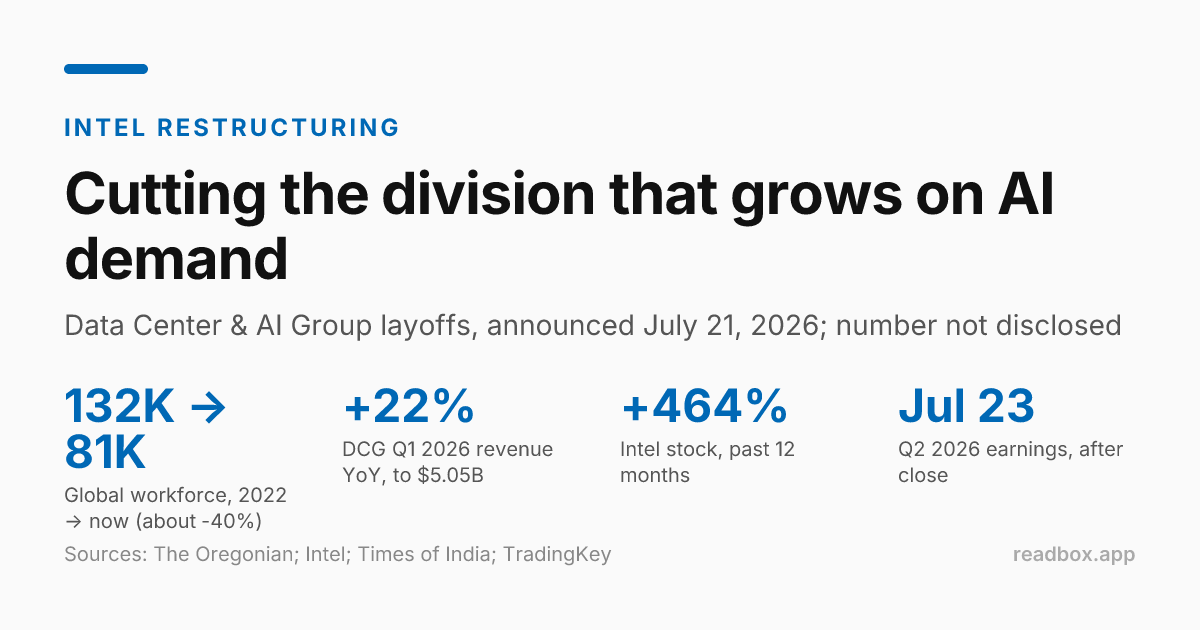
What makes the cut jarring is the division it lands on. The Data Center and AI Group's revenue rose 22 percent year over year in the first quarter of 2026 to $5.05 billion, and Intel's stock has surged 464 percent in the past 12 months on AI-chip and foundry demand, including a chip-supply deal with Apple flagged by President Trump and partnerships with Google and Elon Musk's Terafab project. Intel reports its fiscal second-quarter results Thursday, July 23, after market close, so the cuts land two trading days before earnings.
The stated reason is "focused and efficient" plus "simplicity and speed." The real mechanism is chief executive Lip-Bu Tan's two-year restructuring, not AI replacing workers. Tan took over in March 2025 and promised "no more blank checks," cut management layers by roughly half, and targeted a 15 percent workforce reduction to about 75,000 "core" employees. Intel's global headcount has fallen from nearly 132,000 in 2022 to about 81,000 now, roughly a 40 percent drop in four years, according to the Times of India and Intel's own annual reports (about 125,000 at the end of 2023 to about 85,000 at the end of 2025). Tan has also told employees Intel is "not in the top 10 semiconductor companies" by market value and that the turnaround is a "marathon," redirecting the company toward Edge computing and agentic AI.
Oregon is bearing the brunt again. Intel remains the state's largest private employer, but its Oregon headcount has fallen from about 23,000 in early 2024 to roughly 16,000 now, pushing the state's semiconductor workforce to a 30-year low, the Times of India reports. Intel's U.S. layoffs so far have concentrated in California, Oregon, Arizona, and Texas, most enacted in 2025.
This is not an AI-substitution cut. No one in the Data Center and AI Group is being replaced by an AI agent. It is the opposite pattern: the division whose revenue is rising on AI demand is still being squeezed for "simplicity and speed," because Tan's restructuring is structural, not demand-driven. That is the same euphemism family as Xbox's "entrepreneurial change in scope" and Verizon's "cost reset," a efficiency word blunting a headcount cut.
Xero's CEO called a 30-day "perform or leave" program "the AI moment," then sold her last shares
Australian accounting software giant Xero has begun pushing staff rated "Below Expectation" to either take voluntary severance or enter a 30-day performance improvement plan that may still end in firing, a program chief executive Sukhinder Singh Cassidy introduced to Xero's roughly 5,000 employees in a June Slack message and which Forbes Australia reported July 10.
As per the performance process, the Opt Out Program will be offered to 100 per cent of the Below Expectation cohort, as an alternative to the 30-day Performance Improvement Plan.
Singh Cassidy framed the tightening around AI. "As AI changes how work gets done, we have the chance to redefine how small business finance works," she wrote, according to ts2.tech and Information Age. The "Opt Out" severance is also offered to anyone rated "Moderate" two annual reviews in a row. Staff fall into five buckets: Exceptional, Strong, Good, Moderate, and Below Expectation.
The number of people affected is undisclosed, because this is a performance-managed trickle rather than a mass layoff. The real mechanism is quieter than the AI framing suggests. Xero's share-based payment expense jumped 58 percent to NZ$240.1 million, equal to 43.3 percent of free cash flow, up from 30 percent a year earlier, and ex-Melio headcount actually fell by 74 to 4,536 in the last fiscal year, per ts2.tech. The company is absorbing its Melio acquisition, extending an Anthropic partnership to weave Claude into its platform, and testing an AI agent builder called XeroForce. The "AI moment" language does the work that a layoff announcement would, without a number or a WARN filing.
The sharpest detail is the timing of the CEO's own exit. Accountants Daily reported July 14 that Singh Cassidy sold all of her remaining 29,608 Xero shares, about a month after announcing the Opt Out package. Xero cut 800 staff, about 15 percent, in 2023. Its annual meeting is August 27 and half-year results land November 12.
This is the stated-reason-versus-real-mechanism gap in its cleanest form: "meet the AI moment" on the way in, performance-managed severance and a rising stock-pay ratio underneath, and the CEO cashing out while asking underperformers to leave. It is not AI substitution any more than Intel's cut is. It is AI as the respectable cover for trimming headcount.
Also: Amazon labels a Florida warehouse closure "temporary," but WARN law calls it permanent
Amazon filed a WARN notice July 15 to shut its PBI3 fulfillment center in Port St. Lucie, Florida, eliminating 494 jobs effective September 17, with the remainder separating December 17. That follows the TMB8 inventory hub in Homestead, where 616 workers began separating July 2, roughly 1,110 Florida workers combined, TechTimes reports.
Amazon calls both closures "temporary," part of a two-year renovation to robotics-first fulfillment centers. The federal WARN Act classifies any separation lasting more than six months as permanent, regardless of reopening plans, and Amazon's own filings say the separations are "expected to be permanent." Workers get a four-week severance package, transition healthcare, and access to internal transfers; those who do not secure a transfer lose their jobs with no guaranteed right to return. This is warehouse and logistics labor, not corporate tech, and the cuts are operations and automation-driven, so they sit outside the tech-corporate tally above. But the robotics-first renovation is the same AI-and-automation displacement pattern, just wearing a hi-vis vest.
Tracking
Meta. The 4,665 WARN separations across seven California and Washington locations, filed May 22, become final Wednesday, July 22. This is the May layoff of about 8,000, not a new cut. The 26-employee lawsuit claiming AI selected those cuts lost its emergency bid July 17, but the judge carved out four visa-holding plaintiffs and ordered Meta to explain their selection by Thursday, July 23. The preliminary injunction hearing is August 24.
Intel. Q2 2026 earnings Thursday, July 23, after the close, where Tan may put a number or a segment breakdown to the Data Center and AI Group cuts.
Verizon. Q2 earnings Friday, July 24, the first read on the $5 billion operating-expense savings target and whether chief executive Hernan Schulman elaborates on AI's role in the July 16 round, which a spokesman said had "nothing to do with AI."
Xbox. 1,600 of the 3,200 reset cuts are still scheduled through the fiscal year; the WARN-effective date for id Software, ZeniMax Online, Obsidian, and the Washington 605 is September 4. No new Xbox cuts this cycle.
Who's absorbing the talent
Intel is shedding chip engineers in the same quarter it signed an Apple foundry deal and joined Google's and Terafab's AI infrastructure plans, so the people leaving the Data Center and AI Group land in a market that is hiring them, not shedding them. AMD, Nvidia, and TSMC have been the structural absorbers of Intel talent through every prior Tan round, and the scarcity runs the other direction too: ASML is offering roughly EUR 20,000 retention bonuses to hold its employees through 2030, and Oregon's semiconductor workforce has hit a 30-year low, meaning laid-off chip talent is scarce, not surplus. The counter-signal to watch Thursday is whether Tan frames the Data Center and AI Group cuts as a swap, trimming roles in one place while hiring for the foundry and AI ramp elsewhere, the way Thomson Reuters did when it cut 500 engineers and hired 250 AI-native ones.
That’s the reading for this issue.
- Magic Leap Lays Off 193, Abandoning Headsets to Make Parts for AI Glasses Jul 20
- Samsung's 739 New Jersey Cuts Are Mostly a Texas Relocation, and Its Chip Business Just Hit Record Profit Jul 19
- A Federal Judge Won't Block Meta's Layoffs Wednesday, and Wants Answers on 4 Visa Firings by Thursday Jul 18
- Verizon's "3,000 Layoffs" Are Mostly a Store Transfer, and Microsoft's Security Chief Fired Eight Execs to Go AI-First Jul 17
Want the next one?
Every new Tech Layoffs Tracker issue by email. One tap to unsubscribe.