July 20, 2026
Magic Leap Lays Off 193, Abandoning Headsets to Make Parts for AI Glasses
Subscribe
The $4 billion AR unicorn filed a Florida WARN on July 16 to cut 193 engineers, designers, and executives at its Plantation headquarters by October 1, becoming a waveguide supplier for other companies' AI glasses instead of building its own headsets; Charter is cutting 107 Missouri network engineers to outsource remote monitoring; and Meta's 8,000 May layoffs become final Wednesday as the 26-worker AI lawsuit runs out of emergency options.
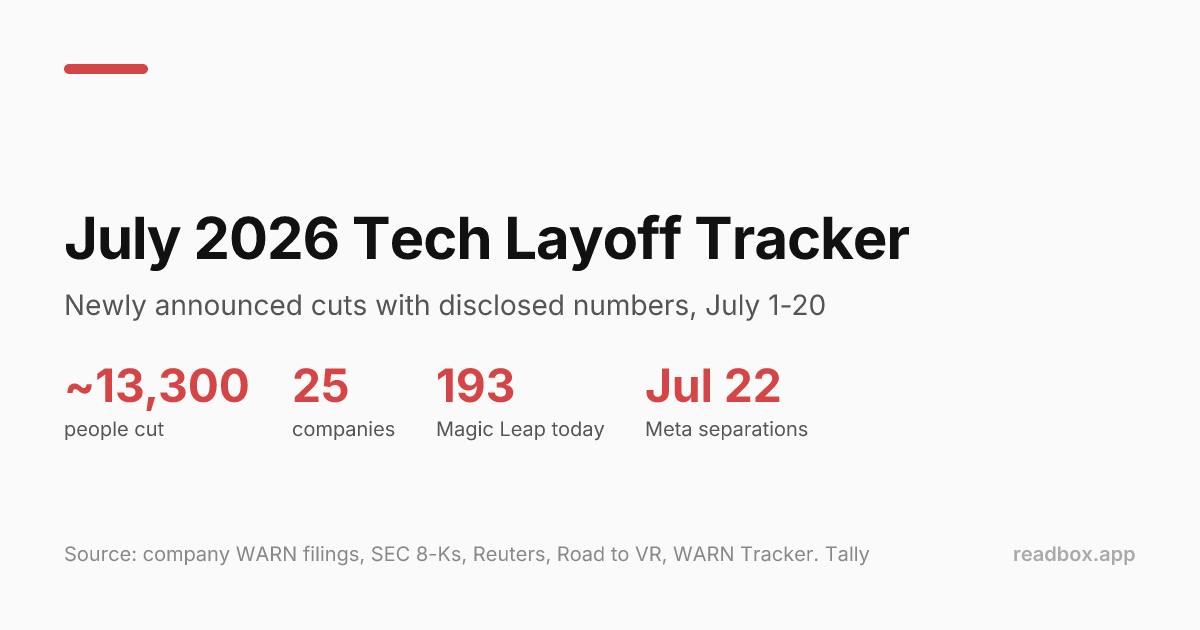
July 2026 so far (through July 20), newly announced cuts with disclosed numbers: roughly 13,300 confirmed layoffs across 25 companies. Today's Magic Leap WARN adds 193 to the tally; Charter's 107 NOC engineers, filed July 8 but not previously tracked here, add the rest. Meta's 4,665 WARN-effective separations on Wednesday are from the May announcement and are not new headcount.
Magic Leap: 193 Cut, Headset Era Over
Magic Leap filed a WARN Act notice with Florida Commerce on July 16 to lay off 193 employees at its Plantation, Florida headquarters, effective October 1. Road to VR first reported the WARN detail on July 20, confirming the scope of cuts that accompany a strategic pivot the company announced on July 9.
The WARN letter lists a wide range of product development and engineering roles affected: software, hardware, UX and design, product management, manufacturing engineering, quality, technical program management, and several senior engineering and executive leadership positions. Road to VR estimates a few hundred employees will remain after the cut.
The stated reason is a "strategic pivot to accelerate the development of AI display glasses." Magic Leap says it is shifting from building first-party AR headsets to becoming the "essential AR ecosystems partner, waveguide supplier, and device integration expert for the technology industry." SVP of display engineering and manufacturing Scott Carden said the company is "solving the toughest challenges of scaling waveguide production" and helping partners "bring AI display glasses to millions of consumers."
The plausible real mechanism is simpler: the headset business never worked. Founded in 2010 by Rony Abovitz, Magic Leap raised more than $4 billion from investors including Saudi Arabia's sovereign wealth fund (over $1 billion), Google, Alibaba, and Qualcomm. Its first headset, Magic Leap 1, shipped in 2018 at $2,300 and straddled consumer and enterprise markets awkwardly enough to force a pivot away from consumers within two years. Magic Leap 2 shipped in late 2020 targeting enterprise only. Abovitz departed in the first pivot. The company has only announced two partnerships since: a hardware deal with Google and a manufacturing deal with Pegatron, both centered on licensing and manufacturing waveguides, not selling finished devices. Bloomberg reported as early as July 2024 that the company was making moves away from first-party devices, characterizing it as a last-ditch effort to monetize its optics technology.
This is not AI substitution. Nobody at Magic Leap was replaced by a language model. The mechanism is commercial failure followed by a supplier pivot: the company burned through $4 billion trying to sell headsets, could not make the math work, and is now selling the most valuable piece of its technology stack (diffractive waveguides and the J-FIL manufacturing process) to companies that believe they can succeed where Magic Leap could not. The "AI display glasses" framing is real in one sense: the companies buying waveguides (Google, and potentially others building Android XR devices) are building AI-first wearables. Magic Leap is attaching itself to that market as a component vendor rather than a device maker.
This is the second mass WARN at Magic Leap. The company laid off 465 workers across Florida, Texas, and Washington in April 2020, including 402 at the same Plantation headquarters. That cut was framed as a COVID-era contraction. This one is framed as a pivot. Both are the same story: a company that could not find a market for its own hardware.
Severance details were not disclosed in the WARN letter or the reporting. The company did not respond to Road to VR's inquiry about remaining headcount.
This lands in the same family as the Lenovo XR pivot covered July 14, where Lenovo dissolved its US ThinkReality XR unit to focus on Motorola consumer AI wearables. Two XR hardware companies, two exits from first-party headsets, two pivots toward the AI wearables wave. The pattern: building standalone AR/VR hardware is harder and more expensive than the 2021 funding environment assumed, and the companies that survive are becoming suppliers or pivoting to adjacent markets.
Charter Communications: 107 Network Engineers Cut at Missouri NOC
Charter Communications filed a WARN notice with the Missouri Department of Workforce Development on July 8 to lay off 107 employees at its Network Operations Center in Town and Country, Missouri, effective September 8. Fox 2 St. Louis reported the filing July 9; DCD confirmed the engineering scope July 17.
The WARN letter, signed by VP of Human Resources Mike Shel, identifies the affected roles with precision: 88 network engineer and network operations positions, 16 NOC managers and senior managers, and 3 directors of network engineering. The letter describes the action as permanent and says the NOC at 941 Charter Commons Street is being discontinued. Other teams in the same building are not affected.
The stated reason is operational: Charter is discontinuing the NOC. The real mechanism, per Spectrum's own clarification to Fox 2, is outsourcing. The company said it "is outsourcing back-office roles to help manage remote network monitoring" and that all affected employees will be offered a comparable employment role in the St. Louis area for at least the next eight months. No customer-facing employees are impacted.
This is a telecom company (Charter operates under the Spectrum brand), not pure tech, flagged here the same way Verizon and Entain are flagged. But the cut is notable for what it says about network operations: a major US cable and broadband provider is closing a dedicated NOC and outsourcing remote monitoring, which is the kind of function that AI-assisted monitoring tools and managed service providers are eating into. Charter did not cite AI. The broader context is cord-cutting pressure (Charter has lost customers year over year and its stock has lost roughly two-thirds of its value in a year) and the pending Cox merger. Severance details beyond the eight-month comparable-role offer were not disclosed.
Tracking: Meta Separations Wednesday, Verizon Earnings Thursday
Meta. The 8,000-person May layoff (10% of workforce) reaches its WARN-effective date Wednesday, July 22. WARN Tracker shows 4,665 positions across 7 locations becoming effective that day, including 1,395 in King County, Washington (699 Bellevue, 259 Seattle, 206 Redmond, 231 remote), filed May 22. This is the same layoff covered in the AI-layoff lawsuit issue July 15 and the ruling issue July 18: 26 anonymous plaintiffs sued claiming AI tools (Metamate, keystroke monitoring, token-usage dashboards) scored and ranked the cuts, penalizing workers on protected leave. Senior US District Judge William Orrick denied the emergency TRO on July 17, letting separations proceed. He carved out 4 foreign-born plaintiffs on Meta-sponsored visas who face "imminent threat of removal" within 60 days and ordered Meta to submit a declaration by Thursday, July 23 explaining how and why those 4 were selected. The preliminary injunction hearing is August 24, when the AI question gets revisited with evidence. Meta's attorney Erin Connell said there is "no evidence that AI was used to make decisions" in the reduction. Not new headcount; the effective date is the milestone.
Verizon. CEO Dan Schulman reports Q2 2026 earnings Thursday, July 24. The third round confirmed July 16 (274 stores sold to franchisees, 500 corporate jobs cut, roughly 3,000 total affected but only 500 counted as layoffs) brings the cumulative total to roughly 16,600 positions removed in nine months (13,000 in November + 620 in May + 3,000 in July). The central question for the call: spokesman Rich Young said the July round has "nothing to do with AI," but Schulman told investors in April that Verizon's "entire AI tech stack" would be "substantially complete" by July, and CFO Tony Skiadas confirmed AI already resolves 85% of network issues without human intervention. The July 16 announcement landed at Schulman's stated July deadline. Whether that framing holds through an analyst Q&A is the watch item.
Xbox. 1,600 of the 3,200 planned cuts are still scheduled through the fiscal year. WARN-effective dates (id Software 136 TX, ZeniMax Online 213 MD, Obsidian 52 CA, 605 WA company-wide) are September 4. The ZeniMax Online leadership exodus (studio head, EP, game director, and production director all out per a July 15 memo) was covered July 16. No new Xbox cuts this cycle. Next potential catalyst: Microsoft FY2026 Q4 earnings, timing TBD.
Hiring Counter-Signal
The AR optics talent leaving Magic Leap is niche but valuable. Google is the obvious absorber: the two companies already have a hardware partnership around waveguides and the Raxium microLED light engine for Android XR glasses. Anduril showed a compact AR glasses prototype July 13, and Palmer Luckey's defense-tech company is one potential destination for AR hardware engineers. The pattern across the XR sector: companies are exiting headset manufacturing but the underlying optics, display, and manufacturing talent is being absorbed by larger platform companies that believe AI glasses will be the consumer form factor. Net still down, but the skill set is not stranded.
That’s the reading for this issue.
- Samsung's 739 New Jersey Cuts Are Mostly a Texas Relocation, and Its Chip Business Just Hit Record Profit Jul 19
- A Federal Judge Won't Block Meta's Layoffs Wednesday, and Wants Answers on 4 Visa Firings by Thursday Jul 18
- Verizon's "3,000 Layoffs" Are Mostly a Store Transfer, and Microsoft's Security Chief Fired Eight Execs to Go AI-First Jul 17
- Xbox Cut the Whole Top of Its Elder Scrolls MMO Studio, and the Studio Head Lasted One Year Jul 16
Want the next one?
Every new Tech Layoffs Tracker issue by email. One tap to unsubscribe.